
Blood pressure changes throughout life, but a higher reading should not automatically be considered normal simply because a person is older. For most adults—including people over 60—blood pressure below 120/80 mmHg remains within the normal category under widely used clinical guidelines.
Children are assessed differently. Their blood pressure is interpreted according to age, sex and height rather than one fixed number. Teenagers aged 13 and older are generally assessed using categories similar to those used for adults.
Understanding the blood pressure normal range by age can help you identify an unusual reading, monitor your heart health and know when to consult a doctor. However, a diagnosis should never be based on a single home reading.
What Is Blood Pressure? Systolic vs Diastolic Explained Simply
Blood pressure is the force of circulating blood against the walls of the arteries. It is measured in millimetres of mercury, written as mmHg.
A blood pressure reading contains two numbers:
120/80 mmHg
| Number | Medical term | What it shows |
|---|---|---|
| 120 | Systolic pressure | Pressure when the heart contracts and pumps blood |
| 80 | Diastolic pressure | Pressure while the heart relaxes between beats |
The upper number is the systolic blood pressure, while the lower number is the diastolic blood pressure. Both are important.
For example, a reading of 145/82 mmHg is considered high because the systolic number is elevated, even though the diastolic number is below 90. Similarly, 128/94 mmHg is high because the diastolic number is elevated.
WHO generally defines hypertension in adults as persistent blood pressure of 140/90 mmHg or higher, confirmed through measurements taken on different days. AHA/ACC categories identify earlier blood pressure elevation beginning at 120–129 systolic and Stage 1 hypertension beginning at 130/80 mmHg.
Blood Pressure Normal Range by Age Complete Chart
Many online charts suggest that blood pressure should steadily increase with age. That can be misleading. Although hypertension becomes more common as people grow older, doctors do not automatically consider high blood pressure healthy or harmless in seniors.
The following BP normal range age-wise chart provides a safe clinical reference:
| Age group | Healthy blood pressure reference | Important interpretation |
|---|---|---|
| Children under 13 | Based on age, sex and height percentiles | A paediatric reference chart is required |
| Teenagers 13–17 | Below 120/80 mmHg | 120–129/<80 is elevated; 130/80 or above needs assessment |
| Adults 20–40 | Below 120/80 mmHg | Repeated higher readings should be monitored |
| Middle-aged adults 40–60 | Below 120/80 mmHg | Age does not make 130–140 systolic automatically normal |
| Seniors 60+ | Below 120/80 mmHg remains the normal category | Treatment targets may be personalised by a doctor |
Blood pressure in children
There is no single normal systolic and diastolic range for every child. A paediatrician evaluates the reading using the child’s:
- Age
- Sex
- Height
- Repeated measurements
For children younger than 13, normal blood pressure is generally below the 90th percentile for age, sex and height. A reading cannot be classified accurately using an adult chart alone.
Normal blood pressure for teenagers
For teenagers aged 13–17, commonly used categories are:
| Category | Systolic pressure | Diastolic pressure |
|---|---|---|
| Normal | Below 120 | And below 80 |
| Elevated | 120–129 | And below 80 |
| Stage 1 | 130–139 | Or 80–89 |
| Stage 2 | 140 or higher | Or 90 or higher |
A teenager with one elevated reading does not necessarily have hypertension. The measurement should be repeated correctly, and persistent elevation should be assessed by a doctor.
Healthy blood pressure for adults aged 20–40
For adults between 20 and 40, a reading below 120/80 mmHg is considered normal. Readings may temporarily increase because of stress, caffeine, pain, exercise, lack of sleep or anxiety.
Persistent readings above the normal category should not be ignored, particularly when the person has obesity, diabetes, kidney disease or a family history of hypertension.
Blood pressure for adults aged 40–60
The risk of high blood pressure increases during middle age, but the healthy range does not automatically change to 140/90 mmHg.
Adults over 40 should have their blood pressure checked regularly because hypertension can develop without obvious symptoms. WHO identifies older age, excess weight, physical inactivity, high salt intake and family history as important hypertension risk factors.
What is normal blood pressure for a 60-year-old?
For a healthy 60-year-old, blood pressure below 120/80 mmHg remains within the normal category.
A reading such as 145/90 mmHg should not be dismissed as “normal for age.” It requires repeat measurement and medical evaluation.
However, treatment targets may be personalised for older adults. A doctor may consider frailty, dizziness, falls, kidney function, diabetes, previous heart disease and other medicines before deciding how aggressively to lower the pressure.
What Is High-Normal Blood Pressure?
“High-normal blood pressure” is an informal term for readings above the ideal range but not always high enough to meet the commonly used WHO diagnostic threshold of 140/90 mmHg.
Examples include:
| Reading | Common interpretation |
|---|---|
| 118/76 mmHg | Normal |
| 126/78 mmHg | Elevated systolic pressure |
| 134/84 mmHg | Stage 1 under AHA/ACC categories |
| 142/86 mmHg | Stage 2 based on systolic pressure |
| 128/92 mmHg | Stage 2 based on diastolic pressure |
A reading between 120–129 systolic with diastolic pressure below 80 is classified as elevated under AHA/ACC categories. A reading between 130–139 systolic or 80–89 diastolic is classified as Stage 1 hypertension.
Someone with a high-normal or mildly elevated reading may initially be advised to reduce salt, exercise regularly, improve sleep, maintain a healthy weight and monitor blood pressure. Medication decisions depend on repeated readings and the person’s overall risk.
Why Does Blood Pressure Increase With Age?
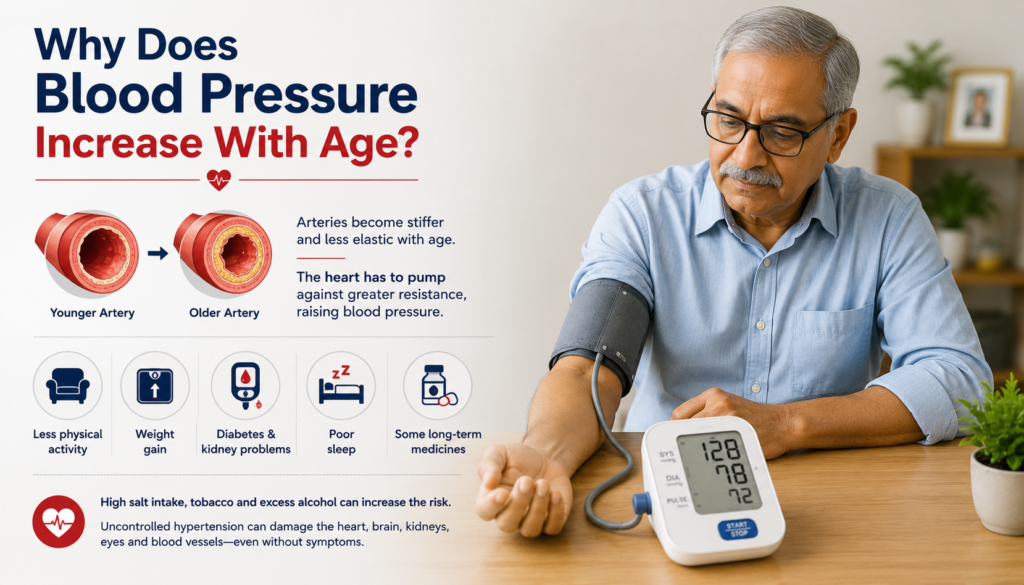
Blood pressure often rises with age because arteries gradually become stiffer and less elastic. The heart may then need to pump against greater resistance.
Ageing may also be accompanied by reduced physical activity, weight gain, diabetes, kidney problems, poor sleep or long-term use of medicines that affect blood pressure. A high-salt diet, tobacco use and excessive alcohol can increase the risk further.
This increase is common, but it should not be treated as harmless. Uncontrolled hypertension can damage the heart, brain, kidneys, eyes and blood vessels even when it produces no symptoms.
Morning vs Evening Blood Pressure Readings
Blood pressure naturally changes throughout the day.
It may rise after waking as the body becomes active. Work pressure, physical activity, meals, caffeine, pain and medicine timing may also affect the result. Some people therefore notice that their morning reading is different from their evening reading.
A small difference can be normal. What matters more is the pattern recorded over several days under similar conditions.
For useful home monitoring:
- Measure at approximately the same times each day.
- Take two readings about one minute apart.
- Record both readings rather than selecting only the lower one.
- Follow your doctor’s instructions regarding measurement before or after medicine.
Do not compare a reading taken immediately after climbing stairs with one taken after resting quietly.
How to Measure Blood Pressure Correctly at Home
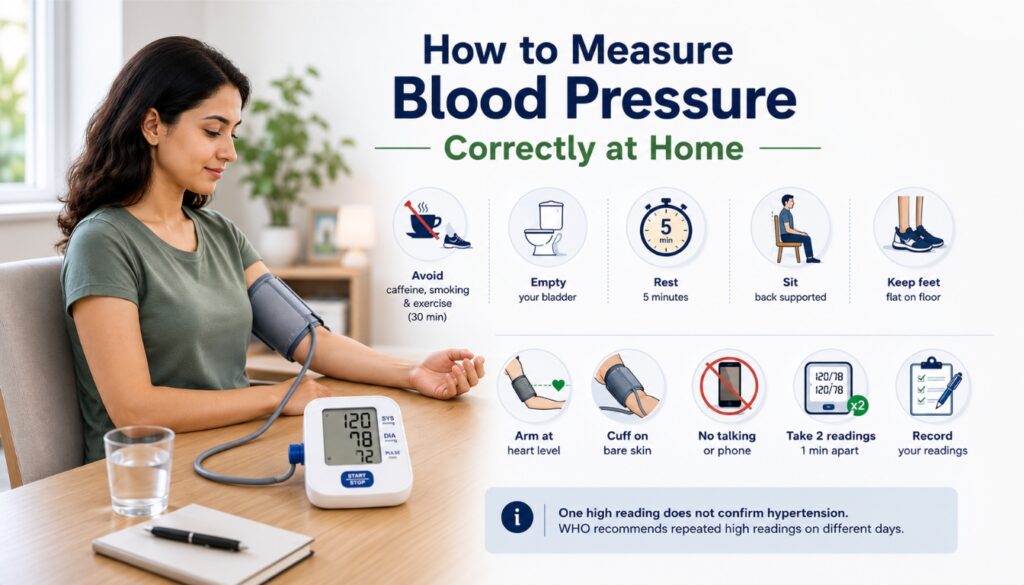
Incorrect posture, the wrong cuff size or recent caffeine can produce an inaccurate result.
Follow these steps for a more reliable reading:
- Avoid tea, coffee, smoking and strenuous exercise for about 30 minutes.
- Empty your bladder before sitting down.
- Rest quietly for at least five minutes.
- Sit with your back supported.
- Keep both feet flat on the floor and do not cross your legs.
- Rest your arm on a table at heart level.
- Place the cuff on bare skin, not over clothing.
- Avoid talking or using your phone during the measurement.
- Take two readings approximately one minute apart.
- Record the date, time, blood pressure and pulse.
One isolated high reading does not confirm hypertension. WHO recommends confirming hypertension through repeated elevated readings taken on different days.
Digital BP monitor tips
A validated automatic upper-arm monitor is generally more suitable for home use than a finger device. The cuff must fit the arm correctly because a cuff that is too small or too large can affect the result.
Keep the machine on a stable surface and replace its batteries when required. Take your monitor to a clinic occasionally so its reading can be compared with a professional device.
Do not increase, reduce or stop blood pressure medicine based on one home result.
When Should You Consult a Doctor?
Book a consultation when home readings remain repeatedly elevated or clinic readings are repeatedly 140/90 mmHg or higher.
You should also seek medical advice when elevated readings occur with diabetes, kidney disease, heart disease or pregnancy, or when your prescribed medicine is not controlling your blood pressure.
A reading above 180/120 mmHg is severely elevated. Repeat it after at least one minute. Seek emergency help immediately when it occurs with chest pain, breathlessness, weakness, confusion, difficulty speaking or sudden vision changes.
Get Your BP Checked at CMCH Hospital Chomu
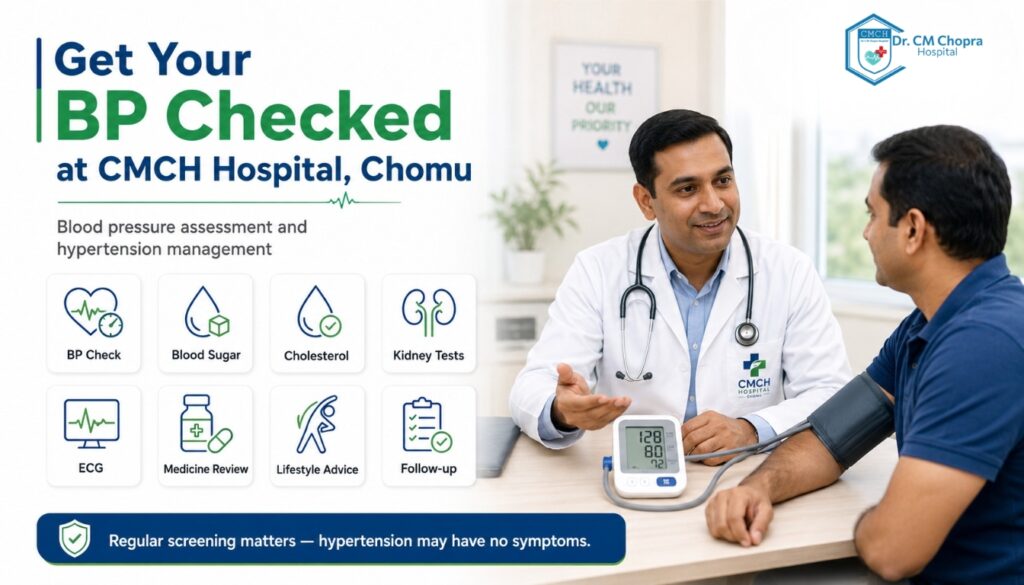
Patients from Chomu, Jaipur Road and nearby areas can consult the General Medicine or Cardiology team at CMCH Hospital for blood pressure assessment and hypertension management.
Depending on the patient’s age, readings and medical history, the doctor may recommend:
- Correct and repeated BP measurement
- Blood sugar and cholesterol testing
- Kidney-function tests
- ECG when clinically required
- Medicine review
- Lifestyle guidance
- Follow-up monitoring
CMCH Hospital provides blood pressure assessment and hypertension consultation through its General Medicine and Cardiology services.
Regular screening is important because hypertension frequently causes no noticeable symptoms. Do not wait for headaches or dizziness before checking your blood pressure.
Related CMCH guides include:
- ECG Test in Chomu & Jaipur: Cost, Preparation & What to Expect
- Heart Check-Up Cost in Jaipur & Chomu
- Heart Attack Symptoms: The Complete Guide
- Chest Pain: Gas vs Heart Attack
Frequently Asked Questions
Is 120/80 normal for every age?
For teenagers aged 13 and above and for adults, a reading below 120/80 mmHg is within the normal category. Children younger than 13 require age-, sex- and height-based assessment.
Is 140/90 normal for a 60-year-old?
No. A persistent reading of 140/90 mmHg or higher should be medically evaluated and should not automatically be considered normal because of age.
What is normal blood pressure for a teenager?
For teenagers aged 13–17, normal blood pressure is below 120/80 mmHg. Repeated readings of 130/80 mmHg or higher require assessment.
Which number is more important?
Both systolic and diastolic blood pressure matter. A raised value in either number can move the reading into a higher category.
Why is my morning BP higher?
Morning blood pressure may be influenced by normal body rhythms, poor sleep, stress, caffeine or medicine timing. Discuss consistently high morning readings with your doctor.
Takeaway
The normal adult blood pressure category does not steadily increase with age. Below 120/80 mmHg remains a healthy reference for teenagers, adults and seniors, although individual treatment targets may vary.
Children require age-, sex- and height-based assessment. For all age groups, repeat measurements and proper technique are more useful than judging health from one reading.
For blood pressure assessment and medical advice, consult the General Medicine or Cardiology team at CMCH Hospital, Chomu, serving patients from Chomu, Jaipur Road and nearby communities.
Medical disclaimer
This article is intended for general health education and does not replace professional diagnosis or treatment. Blood pressure targets may be personalised according to pregnancy, age, frailty, kidney disease, diabetes and cardiovascular history.


0 Comments