A cholesterol level chart by age is one of the most searched health questions — mainly because most people only think about cholesterol after seeing unfamiliar numbers on a lab report. Total cholesterol, LDL, HDL and triglycerides each mean something different, and knowing what’s normal, borderline and high can help you understand your actual heart disease risk rather than just reacting to a number.
This guide breaks down normal cholesterol ranges, what a lipid profile chart looks like across age groups, what your numbers actually mean, why cholesterol is a particular concern in the Indian diet, and how to bring high cholesterol down through lifestyle or medication.
Patients from Chomu, Jaipur Road, Govindgarh, Reengus and nearby areas can get a lipid profile test done at CMCH Hospital, Chomu to check where their numbers stand.
What Is Cholesterol and Why Does It Matter?
Cholesterol is a waxy, fat-like substance found in every cell of the body. It’s not inherently bad — the body needs cholesterol to build cell membranes, produce hormones and support digestion. Your liver makes the cholesterol your body needs, while some cholesterol also comes from animal-based foods.
The problem isn’t cholesterol itself, but having too much of the wrong kind circulating in the blood. Over time, excess cholesterol can build up along artery walls, narrowing them and raising the risk of heart attack and stroke. This is why a routine lipid profile test is one of the most important preventive checks for adults, especially after age 20.
Types of Cholesterol LDL, HDL and Triglycerides
A standard lipid profile measures four numbers:
- Total Cholesterol — the overall amount of cholesterol in the blood (LDL + HDL + a portion of triglycerides).
- LDL (Low-Density Lipoprotein) — often called “bad” cholesterol. High LDL contributes to plaque buildup in the arteries.
- HDL (High-Density Lipoprotein) — the “good” cholesterol. HDL helps carry excess cholesterol back to the liver for removal, so higher HDL is protective.
- Triglycerides — a different type of fat in the blood, not cholesterol itself, but still measured in the same test. High triglycerides are linked to poor diet, excess weight and low physical activity, and raise cardiovascular risk, particularly when combined with high LDL or low HDL.
Cholesterol Level Normal Range Chart by Age
The desirable, borderline and high ranges for cholesterol are set by clinical guidelines (such as NCEP ATP III and the American Heart Association). Current AHA guidance is clear that there is no single “normal” LDL for everyone — your LDL goal depends on your overall cardiovascular risk, not age alone. Total cholesterol under 200 mg/dL is still commonly used as a general screening reference, but it is not itself a treatment target. Cholesterol levels often change with age and can also be influenced by weight, physical activity, diet, genetics and medical conditions, which is why testing becomes more important in your 30s, 40s and beyond.
| Age Group | Total Cholesterol | LDL | HDL | Triglycerides |
| 20s | Below 200 mg/dL, commonly used as a screening reference | Risk-based; often below 100 mg/dL for lower-risk adults | Considered with overall risk, not alone | Below 150 mg/dL |
| 30s | Below 200 mg/dL | Risk-based | Considered with overall risk | Below 150 mg/dL |
| 40s | Below 200 mg/dL | Risk-based | Considered with overall risk | Below 150 mg/dL |
| 50s | Below 200 mg/dL | Risk-based | Considered with overall risk | Below 150 mg/dL |
| 60+ | Below 200 mg/dL | Risk-based; stricter targets may apply | Considered with overall risk | Below 150 mg/dL |
These figures don’t represent different biological cutoffs by age — they reflect the same clinical reference points, applied alongside your individual risk profile. The CDC recommends adults get a baseline lipid profile around age 20, with repeat testing every 4–6 years if levels are normal and no risk factors are present, and more frequently after 40 or if there is a family history of heart disease, diabetes, or high blood pressure. Cardiovascular risk tends to increase after menopause because of changes in hormones, lipids and other metabolic risk factors.
What Do Your Numbers Mean?
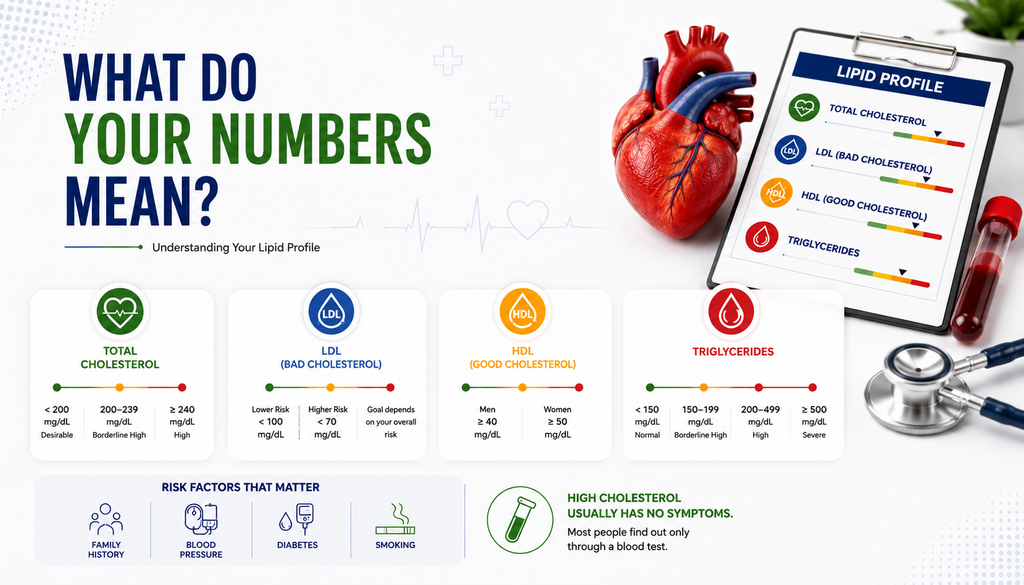
- Total cholesterol under 200 mg/dL is commonly used as a screening reference. 200–239 mg/dL is borderline high, and 240 mg/dL or above is high — though total cholesterol on its own is not a treatment target.
- LDL doesn’t have one universal “normal” number — your goal depends on your overall cardiovascular risk. Many lower-risk adults aim for under 100 mg/dL, while those at higher risk (existing heart disease, diabetes, or multiple risk factors) may be advised to aim lower, sometimes below 70 or 55 mg/dL. Your doctor sets this target based on your full risk profile, not age or a single fixed cutoff.
- HDL is looked at alongside your overall risk rather than as a target on its own — current guidance no longer treats a high HDL number as automatically protective, or a low one as something to treat in isolation. Below 40 mg/dL (men) or below 50 mg/dL (women) is still noted as a risk factor worth discussing with your doctor.
- Triglycerides under 150 mg/dL are normal. 150–199 is borderline high, and 200–499 is high. Levels of 500 mg/dL or above are severe and should be medically evaluated, and levels of 1000 mg/dL or above bring specific treatment urgency due to pancreatitis risk.
Numbers don’t tell the whole story on their own — age, family history, blood pressure, diabetes and smoking status all factor into your actual cardiovascular risk, which is why a doctor interprets your lipid profile alongside your overall health picture rather than one number in isolation.
High cholesterol usually has no symptoms. Most people find out only through a blood test, which is exactly why routine screening matters even if you feel completely fine.
High Cholesterol and Indian Diet
Cholesterol is a particular concern in the Indian context. Traditional cooking often relies on ghee, butter and deep-fried foods — parathas, puris, samosas, pakoras which are high in saturated fat and contribute directly to raised LDL and triglycerides. Sweets made with excess sugar and refined flour add further strain, particularly on triglyceride levels.
South Asians, including Indians, are also recognized by cardiology bodies as having a higher predisposition to cardiovascular disease at lower cholesterol thresholds than Western populations. The Lipid Association of India’s 2023 consensus statement notes that Indians tend to develop atherosclerotic cardiovascular disease roughly a decade earlier than Western populations despite lower average LDL levels — meaning heart disease risk can appear even with cholesterol numbers that might look only mildly elevated elsewhere. This is one reason doctors in India often recommend more cautious, individualized targets for people with existing risk factors such as diabetes or a family history of heart disease.
Combined with increasingly sedentary lifestyles and rising rates of diabetes and obesity, this makes cholesterol screening especially relevant for Indian adults from their 30s onward not just after symptoms or a major health scare.
How to Lower Cholesterol Diet & Medication
Lifestyle changes are the first line of treatment for most people with mildly to moderately elevated cholesterol:
- Foods to eat more of: oats and whole grains, fruits and vegetables, legumes (dal, chana, rajma), nuts, fatty fish, and foods rich in soluble fibre, which helps reduce LDL.
- Foods to cut back on: ghee and butter in excess, deep-fried snacks, red meat, full-fat dairy, and refined sugar and white flour, which raise triglycerides.
- Physical activity: at least 150 minutes of moderate activity a week — brisk walking, cycling, swimming — helps raise HDL and lower triglycerides.
- Weight management and quitting smoking both meaningfully improve cholesterol levels and overall cardiovascular risk.
Medication becomes necessary when lifestyle changes alone aren’t enough, or when LDL is very high, or when there is existing heart disease, diabetes, or significant cardiovascular risk. Statins are the most commonly prescribed medication to lower LDL, and your doctor will determine what target and treatment plan is right for you based on your full risk profile — not cholesterol numbers alone.
It’s also worth knowing that high cholesterol rarely travels alone. Combined with high blood pressure, cardiovascular risk rises substantially — the two conditions compound each other’s damage to artery walls. If you’re managing (or unsure about) your blood pressure too, it’s worth reading our guide on high blood pressure symptoms and hypertension, since checking both together gives a much clearer risk picture than checking either alone.
Lipid Profile Test at CMCH Hospital Chomu
A lipid profile test is a simple blood test that measures total cholesterol, LDL, HDL and triglycerides. Depending on your clinical situation, your doctor may recommend either a fasting or non-fasting test — current guidance allows both, so follow whatever preparation instructions your doctor or the lab gives you.
CMCH Hospital, Chomu offers lipid profile testing along with cardiology consultation for patients across Chomu, Jaipur Road, Govindgarh, Reengus and nearby areas, including:
- Lipid profile and related blood tests
- Cardiovascular risk evaluation
- Guidance on lifestyle changes and, where appropriate, medication
- Follow-up monitoring for patients on treatment
If you haven’t had your cholesterol checked in the last few years — or if you have risk factors like high blood pressure, diabetes, obesity or a family history of heart disease — it’s worth getting a lipid profile done rather than waiting for symptoms that may never appear before a cardiac event. For more on recognizing heart-related warning signs, see Heart Attack Symptoms: The Complete Guide.
Frequently Asked Questions
What is a normal cholesterol level by age?
Clinical reference points don’t change by age — total cholesterol under 200 mg/dL is commonly used as a screening reference, and triglycerides under 150 mg/dL are considered normal. LDL doesn’t have one universal “normal” number — it depends on your overall cardiovascular risk. Cholesterol levels do tend to rise naturally with age, so testing becomes more important over time.
What are high cholesterol symptoms?
High cholesterol usually has no noticeable symptoms. It’s typically discovered through a routine blood test, which is why regular lipid profile screening is important even without symptoms.
What is a normal LDL and HDL level?
There’s no single normal LDL for everyone — your goal depends on your overall cardiovascular risk, and your doctor sets it individually. HDL is considered alongside your overall risk rather than as a target on its own, though below 40 mg/dL (men) or 50 mg/dL (women) is still noted as a risk factor worth discussing with your doctor.
Does Indian food really increase cholesterol risk?
Traditional Indian cooking often includes ghee, fried snacks and sweets high in saturated fat and sugar, which can raise LDL and triglycerides. Portion control, cooking methods and overall dietary balance make a significant difference.
Can high cholesterol be managed without medication?
Yes, in many cases. Diet changes, regular physical activity, weight management and quitting smoking can meaningfully lower cholesterol. Medication is added when lifestyle changes aren’t enough or when cardiovascular risk is higher.
Medical Disclaimer
This article is intended for general health education only and does not replace professional medical consultation, diagnosis or treatment. Speak with your doctor to interpret your personal lipid profile results and cardiovascular risk.

0 Comments